Saturday, December 10, 2011

Recess: a Right or a Privilege?

Okay, this is a pet peeve of mine.  Often recess is taken away for misdeeds in school.  Consider the reasons:  forgotten homework, incomplete work, distracting behaviors.  More than likely, these are related to specific issues a child might be struggling with:  organization,  slow processing, hyperactivity.  Why then are we limiting the activity that would likely help these students?  We know that movement is beneficial for successful performance in school.  With the rise of childhood obesity and diabetes, why take this away?   Recess is golden!

Let's consider sensory patterns of our kids and how recess may be a good vehicle for providing input.  Winnie Dunn, author of Living Sensationally, looks at ways that we respond to sensory input in everyday life and groups these into 4 categories:
  • Seekers (those who can't get enough) 
  • Bystanders (those who miss events going on around them)
  • Avoiders (those who try to get away or manage their surroundings)
  • Sensors (those who detect everything, nothing gets by them)
Of course, human beings are complex and don't fit neatly into these categories.  These patterns do help our understanding of how sensations in our lives support or hinder our participation, however.  In her book, Winnie describes these sensory patterns and how they affect choices we make in life. There is a Sensory Patterns Questionnaire in the beginning to help you understand your own unique sensory pattern.

Students do not have to earn the right to participate in school tasks by coming to the table with everything in order.  As professionals, we are responsible for making participation happen immediately.  Recess is such a rich tool to provide kids with what they need no matter what sensory pattern they have.  Here's how you can use recess to address individual sensory needs and styles:
  • Seekers (provide more opportunities):  This is a no brainer.  These kids need to run, climb and move to their hearts content.  Typically, they make good use of their recess time to prepare their bodies for learning.  Think twice before you make recess a consequence.
  • Bystanders (provide more intensity):  There is plenty out on the playground to help these folk.  Look at more intense experiences (tire swing, high slide, climbing ropes).  Provide new games or play activities.  Keep the novelty going.  Encourage different tag games, for example.
  • Avoiders (make less input available):  Help them to find those spaces that limit the intensity of input while providing quieter play arenas.  Many structures have spaces underneath to gather and play.  Develop play routines to insure participation.
  • Sensors (provide more structured input):  Think about how paying attention to everything might affect play.  Soccer is sometimes played on our large field or in a more confined space (tennis court).  The tennis court option provides a space with boundaries, limiting distractions.  Pair a child up with another person to remind them what game they are playing.
Okay, now let's move!

Friday, December 09, 2011

What Is Your Sensory Plan?

At a meeting we were talking about a student's low alertness level and the need for sensory activities to give him a boost at specific times.  OTs often propose adding movement breaks, heavy work or touch activities.  This all makes more sense when you look at what you do to enhance your own participation throughout the day.  I, for one, am quite alert in the morning but lose it shortly after the sun goes down.  It has been a challenge this week with all the Christmas parties on the calendar.  I struggle to stand and make conversation when I am tired.  Today I planned ahead by providing a "sensory diet" for myself.  My idea was to swim.

I thought I was done with swimming for the year, but it was another 50 degree day.  In I went. Jumping into cold water makes you come out with a smile, perhaps even a bit giddy.  Believe me, I watch others who are doing the same.  I feel instantly energized and this has a lasting effect on me well into the evening.  I am more alert and definitely more social.  As a result, tonight's party was quite fun and I could actually enjoy it.  What is your sensory plan?


Thursday, December 08, 2011

Mixing Things Up


I am avoiding pencils this week so I brought out the watercolors for the kids.  Why stick to painting on the tabletop or easel?  Leaning back and painting UNDER the table top is quite engaging.  Reaching up against gravity builds arm strength as well.  It just seems right to shake things up once in a while.

Wednesday, December 07, 2011

Visualizing Time

I don't wear a watch, but I am quite accurate at telling the correct time within a few minutes.  I don't use an alarm clock but I can wake up just by setting my internal alarm.   Still, time escapes me.  I should say the "passage of time."   I never know how long a task will take me.  I stink at cooking because I can't coordinate the timing of all the items.  I am constantly surprised with the change of seasons. "What, it's winter already?  What happened to fall?"  I am sure I have a different perception of time than most.  My favorite calendar app looks like this:


That's why I love Time Timers.  They are handy little clocks that demonstrate the passage of time in a simple, clear manner.  They come in 3 different sizes.  The current models have an optional audible signal upon completion.  You can get the TimeTimer as an iphone/ipad app or software for your computer.  This video explains them well.


Our students benefit greatly from knowing how long they will be working on a task.  For all they know, it could be forever!  Give them the benefit of time.

Tuesday, December 06, 2011

Purely Visual


These bottles of colored water sit on the windowsill of our school room.  They make a nice visual break.  We have some empty ones for students to experiment making their own colors.  Check out other bottle ideas here.

Monday, December 05, 2011

Diving In


Last June, after the school year ended, I started thinking of habits.  They say it takes 21 days to establish one.  Getting in the water each day of July came to mind.  There were no strings attached.   I just had to submerge.  This promised to be easy since I was in Newport for the summer, down the block from the bay and only a couple of miles from the ocean.  As the days came and went, I soon learned to jump in whenever the opportunity presented itself and the earlier in the day, the better.  I leaped from the pier, swam off the boat ramp at high tide and dove in the waves after a morning run on the beach.  There were a few challenges, sure.  I had a conference in Boston that took me away from my water holes.  This required me to take predawn dips in the town lake (it was questionable whether swimming was allowed, but I didn't look too closely).  I drove out of my way to find a pond out in the country.  Back home again other challenges popped up, but each came with a lesson.  I learned to stay calm swimming in the midst of jellyfish that felt like a sea of tapioca.  Red tide caused me to close my eyes, but I kept my strokes going.  A thunderstorm appeared out of nowhere and I never swam so fast towards the shore!  Some of these swims were solo but many were with family members and friends.  It is always encouraging to have someone to share in your antics.

Thirty one days of July passed by, each day with a water adventure.  Before I knew it, August was half over and I was still getting in the water.  Why not keep up the streak?  I ended August with the same record, despite Hurricane Irene's visit.  Now, whenever the opportunity presents itself, I can't help myself.  I need to get in the water.  We have been having a string of warm days here outside Boston in December.  Today was close to 60 degrees.  I swam at Walden pond after work.  It energized me, especially in these waning days of sunlight.

Now I am applying this same habit training to my blog.  I will write one post daily.  No stings attached.  It may be just an image, but it will be a daily visit.  As I look at the last time I posted, I realize I need this shot in the arm.  So here goes.  I am diving in!

Friday, May 27, 2011

The Art of Making Life Easier - Tying Shoes

I happened by this TED video this morning on tying shoes. Apparently most of us have been doing it the wrong way all of our lives. No, the incorrect way is not the bunny ear technique. Check this out:


Of course, I needed to grab my shoes to see if I was using the weakened knot method. Happily, I have been tying my shoes the correct way, so I will not have to reteach myself. If you are one of those unfortunate people who have been tripping on their shoelaces because of a faulty knot technique, consider making the change. You will have to establish a new motor memory pathway and it will feel awkward at first. All you need is 21 days to form a habit, so check back with me next month!

Last year, a fifth grade teacher approached me at the end of the school year. She said that a particular student in her room requested to talk to me about a sensitive topic. I wasn't sure what to expect when he came to me, but he confessed that he could not tie his shoes. He did not want others to know that this skill somehow got by him. Well, with a couple of weeks left of school, we had a dilemma. I asked him if he had access the internet at home. He assured me he did. I created this flip video, posted it on Vimeo and told him to practice it at home. He could replay it as many times as he needed.


The next week he saw me in the hall and said he was tying his shoes...success! That is the power of visual demonstration provided in a way to make it easily accessible.

Monday, May 09, 2011

A day in the life of an OT with an iPad...

I bought myself an iPad last summer and work has not been the same. To explain this best, I thought I would give you "snip-its" of my day today with one in hand.

As I walk into school, my briefcase is much lighter. I leave my school lap top at work now and in its place is the feather weight iPad. It is amazing how heavy those school laptops are!

I stop in a kindergarten class to work with a youngster with weak hands and poor fine motor skills. He is finishing up a center activity, a mosaic paper tearing task. I demonstrate how to tear paper with the tips of his fingers instead of a whole hand grasp. He signs his name on the back with a more confident signature. His lines are darker and straighter instead of light and wavy. It must be the prior finger activity preparing his muscles and joints. Next, we use pop-toobs as a two-handed task to build arm strength. They make a very satisfying sound. After stretching them out, I have him put one end to his ear as he repeats positive affirmations ("I am amazing") in the other end.

We open the iPad and use Doodle Buddy to practice drawing a person. We sing the Mat Man song to help guide his drawing of body parts. By holding down the home button and on/off switch at the same time, we take a photo of his drawing. He goes to the photo app and compares the drawing with one he drew several weeks ago.


Finally, we open the Dexteria app to the Tap IT activity, a finger dexterity and isolation task. He is learning to isolate individual finger movements, something needed in order to manipulate a pencil to form letters, type on a keyboard or play a musical instrument. Hmm...he has improved over the past month when all his fingers moved at once.

I consult on a youngster in second grade with challenges in attention, sensory regulation and motor output. As I walk into his classroom, he is finishing up a story on crocodiles. I check up on the writing strategies we developed for him. After just 5 minutes of working with him, it is snack time (you don't own the schedule when you are a school based therapist!). The student is ready to be done with writing, and is hungry to boot! As he eats his snack, we keep the focus on crocodiles. His most recent page in his story is on crocodiles and predators, so we look up more information by googling this using Safari. Because the iPad is "instant on", we don't miss a beat. If I was waiting for a laptop to open up, I might have lost his interest. We discover an interesting article on Animal Planet. I read the information to him, but he could have listened to it using VoiceOver (an accessibility feature built right into the iPad). Next, I refine the search to images. This brings up many intriguing photos of crocodiles and their predators. The student remains engaged, building his knowledge base. He scrolls through the images, enlarging them with a two finger touch and goes to the link to get more information. After snack, he hasn't "checked out". He uses his writing checklist to make corrections in his story for capitalization, punctuation and spelling. He then transitions to the next activity, energized from this experience. The iPad supports the third principle of UDL, for sure!

After lunch, I have an IEP meeting. Several years back I took notes by hand. I was a terrible filer and I struggled with an ever-growing pile of paper on my desk. Last year I moved to typing notes on a laptop. I never liked the separation a laptop created on a table. Often, I would keep the laptop on my lap to avoid this.

Today, I open Notes and start a new page for this meeting. The iPad can sit flat or with a slight incline. It does not create a barrier between you and others at the table. It is like writing on a piece of paper. We consider different writing support programs for this student. One is Clicker 5. As the special educator explains the program to the regular ed teacher, I bring up the website and show an image of the tool. As the meeting adjourns, I put my iPad to sleep. This is one note I will not misplace on my desk.

At the end of the day, I open the First Class app and send a few follow-up emails.


My day with an ipad...doing things differently. I wouldn't have it any other way.

Saturday, April 16, 2011

Expression through Song

April is Autism Awareness Month. Barbara Smith, The Recycling Occupational Therapist on Facebook, shared this link to a youtube video. This creative expression through song on Aspergian pride (I don't fit the template) is a single by Johnny Medlar.

Sunday, March 06, 2011

Reading for Enjoyment

Smories


Smories is a free resource where kids can have stories read to them by other kids. It's a simple, safe alternative to sites like youtube where young viewers can click away to unknown destinations. Here is how it got started:
We got the idea for smories.com during an extremely long journey in a very dirty Land Rover from the Kalahari desert in Botswana to Cape Town in South Africa in February last year.

Our daughter (8) had the idea to film herself with our ipod reading Enid Blyton short stories, and then play them back to her younger sister (6). This kept them entertained for hours.

Our kids have always loved reading to each other and are transfixed when other children read them stories. They are also obsessed with the internet and will make their way to youtube any time they get their hands on a computer.

We thought a website that had a continuous flow of new stories, read aloud by kids, would make a healthier destination than so much of the stuff out there. Imagine you're stuck in traffic and need to keep a miniature person entertained in the back. Access a playlist of smories stories from your i-phone and voila...
Check it out. There are stories for 3-4 ish, 5-6 ish and 7-8 ish year olds at this point. The children reading them are mostly from the UK. They are so engaging!

They made a special version of Smories for the iPhone and iPad. Visit www.smories.com in your iPhone, iPod touch or iPad, and you'll see what they mean. ***We recently introduced an ipod cart here at Hosmer...just in time for students to watch these lovely stories during reading month.

Read!


March is Read-a-thon month at Hosmer. It is a wonderful, longstanding tradition. Parents, teachers and students all join in on this 31 days of reading fun. This past Friday was Hat Day. It was delightful to see the students express themselves through the hats they wore. It clearly was an example of the third principle of Universal Design for Learning - "offering multiple means of engagement".

I hope to post various reading related activities and sites, so keep checking back! Meanwhile, curl up with a good book.

Wednesday, January 19, 2011

National Handwriting Day


copying
Originally uploaded by lloydcrew
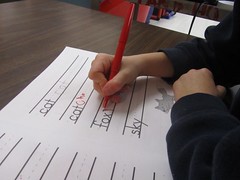
National Handwriting Day is on John Hancock's birthday, January 23 (although there is some debate that his birthday is actually January 12). Take this opportunity to stress good handwriting with your students. Why not post a large birthday card to John in the school hallway and have the students sign with their best signatures? For more ideas, check the Handwriting Without Tears website.

Friday, January 07, 2011

Stepping Out


Get moving
Originally uploaded by lloydcrew
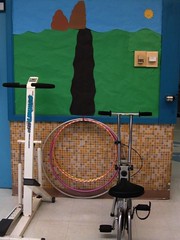
Ten years age Ms. Donovan, first grade teacher, had a "stepper" in her room. It was a bit unusual as a classroom tool, but it made perfect sense. When antsy youngsters needed breaks, they had a place to go that was not removed from their learning environment. As a piece of furniture, it was ideal. It stood upright without demanding a lot of space. The students would be directed to "step out the alphabet" or "count backwards from 12" before returning to work. Well, that mythical movement machine made its way to several classrooms but has since disappeared from the halls of Hosmer. I still keep my eyes out for ones on the curbside.

Here is our "Get Moving" station right inside out room. Students start or end their sessions with a boost. Others students come by for a 5 minute alertness break.

What do you have hanging around your basement?

Thursday, January 06, 2011

Containment


Originally uploaded by lloydcrew
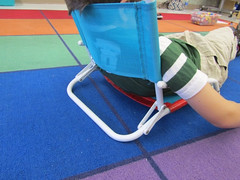
Getting kids to sit and attend on the rug is a real challenge. Sometimes giving more support is helpful. One favorite item at our school is the beach chair. Having back support works in some cases. As you can see in this photo, it is not always the answer, however. Without movement, this student is melting into the rug. Our solution was to add a small air cushion to the seat of the beach chair. It helped to change this youngster's alertness level, sitting posture and attention!

Wednesday, January 05, 2011

Wiggling Feet


Originally uploaded by lloydcrew
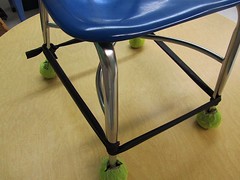
Theraband is great material to wrap around legs of chairs. Kids can use it to bounce their feet on, keeping them alert and on track. They can use it as resistance to stretch against. They can reach down, grab the band on each side and pull up to give their writing hand a break. We usually run out of this material and it can be expensive. Go to your local bike shop and have them save old bike tubes for you. They work just as well.

Let kids move!


Let kids move!
Originally uploaded by lloydcrew
Remember, our bodies were not made to sit in a chair at a desk all day...let kids move! How can you build movement into a student's day? Check in daily this week for suggestions!

Thursday, September 23, 2010

Moving Day

This school year started with a move. As bad as it was, there were positive things about it...look what developed as part of our new space.


Sunday, June 13, 2010

Great OT Blog

I love looking at this blog, OT Tools for Public Schools...lots of ideas and always pictures! Add it to your list.

Saturday, June 12, 2010

Connect the Dots


Who doesn't love dot to dots? This site allows you to create a "connect the dot" image from a photo. It is great mouse practice. I made mine a little too detailed to be clicked on easily, but you should try one of your own. What a great end of the year activity for your students.

Monday, March 01, 2010

How To...


There is something appealing about completing something in 5 steps. Displaying these 5 steps can be accomplished with a simple list, but check out how it is done using a mind map. Certain students may find this "big idea", visual approach very helpful. See for yourself at Paul Foreman's blog, Mind Map Inspiration.

Saturday, February 27, 2010

"At Attention" vs. Topsy Turvy

Why do we demand that students face the front with eyes on the adult during a talk or lecture?  Read this post on Everyone Listens Differently and see if you change your expectations for attention.  The bottom line is, know your students.  Know what engages them.  Know what  "participation" looks like for them. 

I have a fourth grade student with autism.  His instructional assistant is a little perplexed by his listening style, but doesn't try to change it. "He'll sit leaning off the chair with his head upside down but when I ask him about what the teacher was saying, he knows it all."  As an OT, I recognize that his is getting needed vestibular input through the positional change in his head.  This can be quite alerting.  As a student of Tai Chi, I can hear my instructor say. "Everybody needs to spend some part of their day upside down."


I have another fourth grade boy with ADHD who struggles to stay focused in his seat.  He disrupts others by talking and moving around.  I asked him what would help him in class.  Without hesitation he said "a chair that swivels".  I had just visited the site The Third Teacher and read this passage:

‘Growing bodies have a natural need to move,’ explains Dr. Dieter Breithecker, Europe’s foremost expert on the relationship between ergonomic design in educational furniture and the physical development of school children. ‘Increased opportunities to move while seated, including rocking, swiveling, and rolling, improve blood flow and oxygen to the brain, thereby increasing attention and concentration levels.’
Idea # 22 fom the site is Swivel to Attention
Give students furniture that lets them twist and lean safely. The movement will increase their ability to concentrate.
My student knew what he needed.  There is a biological need behind it.  It is not just something "fun and frivolous". 

Know what  "participation" looks like for your students.


Friday, December 04, 2009

Bubblewrap...The Real Stuff or The iPhone App?

OTs love bubble wrap.  It is such a sensory experience...the feel, the sound, the excitement!  We tape a sheet at the entrance of our room with a sign saying "please pop".  Now the iphone has an app for that.


Why not use both?  It follows the UDL principle of multiple means of engagement!

Saturday, November 21, 2009

Sweeping Off the Cobwebs of this Blog

Habits...they are good when they are established, but boy can they break down! I have gotten out of the "habit" of communicating with this blog, but I am jumping right back into it. I liken it to jumping into Walden Pond which I did yesterday - a bit chilly but invigorating!

I will start again with one thing I learned this morning on Twitter (I got this idea from my friend Karen Janowski over at her blog).

Today's find was an article on FLOW, especially as it relates to teenage learners. I think you will find it interesting!


Wednesday, September 09, 2009

Today is...

09/09/09

Here are some fun activities you can do in class today to celebrate the number nine. Thanks to Jen at Far-Out Links to Learning. I think I'll have my students take nine deep breaths to start off their morning.

Wednesday, September 02, 2009

Summer Ends


Summer is a valuable time for removing yourself from routine tasks and dreaming a bit. Where did your path lead you? Are your ready for the adventure of school?

I once asked the three year old daughter of friends how her parents were doing. She responded, "Same old, same old."

Really? How can anything in your life be "same old, same old" when you are only three? Can we describe our classrooms and work in school in a similar manner? Bring in your dreams, new designs and fresh approaches. Keep learning. Join twitter for your professional growth. Let the journey begin!

Tuesday, September 01, 2009

Classroom Jobs - Think Digital

As you set up your rooms this week, why not add digital jobs to your job chart? In addition to "line leader" and "table washer", add "homework helper". This student could explain the first math problem in the homework using Voicethread, providing support to any student who gets home and forgets the process to solve a problem. It is also helpful for parents to understand the steps of the homework...how often as parents do we hear, "That's not how we do it in school!" Check out this example.

What other "digital jobs "can you add to you class job list? Add a comment and I will create a post of all your ideas.

Tuesday, July 21, 2009

The Power of Our Hands


OTs have a fascination with hands. It is through our hands that we interact with the world around us. Our hands calm others, take in information, manipulate tools, create masterpieces and are a vehicle for our imagination. Recently we have limited our hands in school to pencils and books. Are our hands having even less a role in this digital age we live in? Watch Pattie Maes from the MIT Media Lab discuss new technology that uses our hands and natural gestures to interact with our environment.

Wednesday, June 03, 2009

Webspiration is Open for (Free) Business Again!


Now you can get a free account to My Webspiration, an online web mapping tool. They opened the site up to new users again, so go for it. MyWebspiration

Wednesday, March 25, 2009

UDL in the Skies OR Soaring Senses

My colleague Lindsay and I just completed teaching a course on "barrier-free learning", incorporating Universal Design for Learning principles (UDL). A key feature of UDL is offering multiple means of representation, expression and engagement. Watch this video to see how a flight attendant engaged his audience in a way that sparked the interest of his passengers and encouraged participation. Imagine bringing this into the classroom!


The Rapping Flight Attendant - Watch more Funny Videos

Using Winnie Dunn's classification of sensory patterns, I would identify this particular flight attendant as a "sensory seeker". He added increased sensory input to his typical routine to keep himself and the passengers more alert. Check out Winnie Dunn's book, Living Sensationally - Understanding your Senses to learn more about sensory patterns in everyday life.

Thanks to @rmbyrne for his blog post highlighting this video. Check out his blog Free Technology for Teachers for a wealth of resources at your fingertips.